
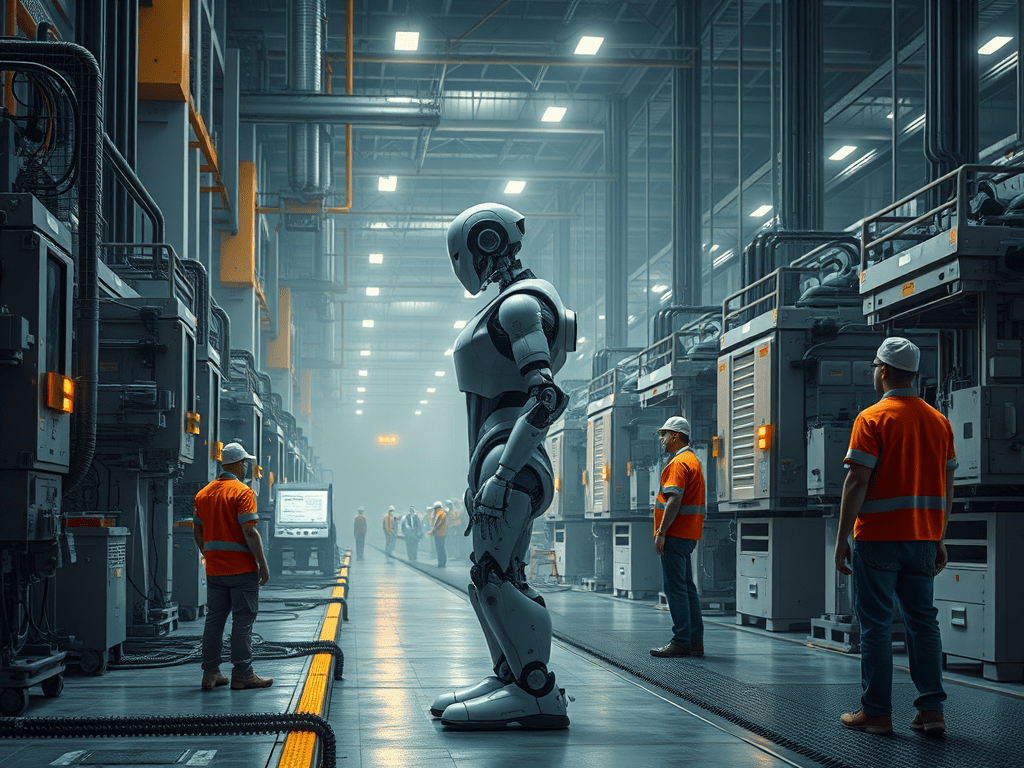
- New Zealand’s National AI Strategy doesn’t even mention employment impact and is unprepared for job displacements.
- Economists Korinek and Stiglitz argue that we must actively steer AI to enhance jobs to avoid the problems that led to dissatisfaction and populism with the advent of the internet and automation.
- The workers must be actively involved in decisions regarding AI deployment.
- New Zealand lags behind most countries in AI deployment and is likely to fall further behind other rich countries in productivity and prosperity.
New Zealand’s AI Strategy was launched in July, with not even a mention of employment.
Chrisana Archer, Digital Futures Manager at MBIE, appears to justify a wait-and-see approach due to our historically slow uptake of new technologies. It seems counterproductive for a country lagging behind on productivity to plan to be late to the party again. While there are optimistic forecasts about AI adding jobs, the disruptions and displacement of thousands of jobs is certain. Can we afford to delay an AI employment strategy?
Anton Korinek, Professor of Economics at the University of Virginia, and Nobel Prize-winning economist Joseph Stiglitz argue that we must actively steer AI to enhance jobs rather than displace them. The internet and automation revolution led to the loss of well-paying jobs in the developed world and dissatisfaction, which contributed to the rise of populism. We can’t afford to tackle the coming AI revolution poorly and add fuel to the already burning fire.
Many recent innovations, like the internet and automation, along with political changes and lessening of union influence, focused on labour-saving and offshoring. The result was not just temporary labour saving but permanent wage reductions. Low-paid jobs in retail and hospitality replaced good jobs for workers in factories and mills. Weekly wages (adjusted for inflation) have risen by 39% since 1990, while GDP has increased by 57%. I suspect that the after-tax wage increase is even lower due to the shift from income taxes to GST.
If AI development continues along this path, we face the prospect of a future where machines can perform even more tasks more cheaply than humans and drive salaries even lower.
Whether the impacts of AI are beneficial to workers depends on several factors. Will AI enhance worker productivity or replace them? How much of the productivity gain will go to the workers? Will the lowered cost of products expand the market? Are the workers affected by AI those who are highly paid or already disadvantaged?
Korinek and Stiglitz advocate that governments actively steer AI towards labour-friendly progress. Guiding technologists’ and entrepreneurs’ choices that affect labour markets to create more inclusive prosperity. Shifting taxes from wages to corporate and digital taxes. Direct government research spending to labour-enhancing innovations.
Empowering workers in technology decisions with workers’ councils and labour representatives who participate in corporate decision-making can help steer companies away from technologies designed to make workers more replaceable. Jobs provide more than just income—they offer identity, meaning, status, and social connections. When evaluating the impact of technology, we should consider these non-economic aspects.
Some AI is labour-friendly. Diagnostic AI systems that augment, not replace, healthcare professionals, providing analysis that doctors can use in decision-making. Note-taking apps for GPs are already in use. AI assistants that guide and upskill less-skilled workers. Educational AI can personalise learning to help workers develop new capabilities throughout their careers. Communication tools could help teams collaborate across language barriers.
However, these strategies may not help forever. We are likely to see more worker replacement as AI models improve. AI-powered machines might be able to provide sufficient goods and services for a high standard of living for everyone with fewer work hours. We will likely need shorter working weeks and practical versions of universal incomes for all workers to have a high standard of living and meaningful work. A winner-take-all economy that creates mass unemployment will be a nightmare.
Korinek and Stiglitz emphasise that high stakes are involved and a long-term future in which the traditional relationship between labour and capital may be fundamentally altered, with technological progress serving human flourishing.
The path of technological development isn’t predetermined—it’s chosen and will shape not just our immediate economic landscape but the very foundations of our society for generations to come.
In New Zealand, our governments tend to think very short-term. The coalition is investing only $10 million per year for the next seven years to develop and adapt AI. (For comparison, the Ministry of Social Welfare’s computer system upgrade will cost between $1.8 -2.1 billion.) Our investment in Research and Development is only 50% of the OECD average.
The coalition’s policies overwhelmingly favour businesses over employees to the extent that our Workplace Relations Minister and the Prime Minister refuse to even meet with union representatives. Minimum wage workers face cuts to real wages in the first two years of the government, which are likely to continue. We seem to be stumbling around like a worker living paycheck to paycheck, rather than investing in our future.
We must get back to the fundamentals. Democracy, being for the people first and foremost, in a future that is likely to be very different.

Leave a comment