
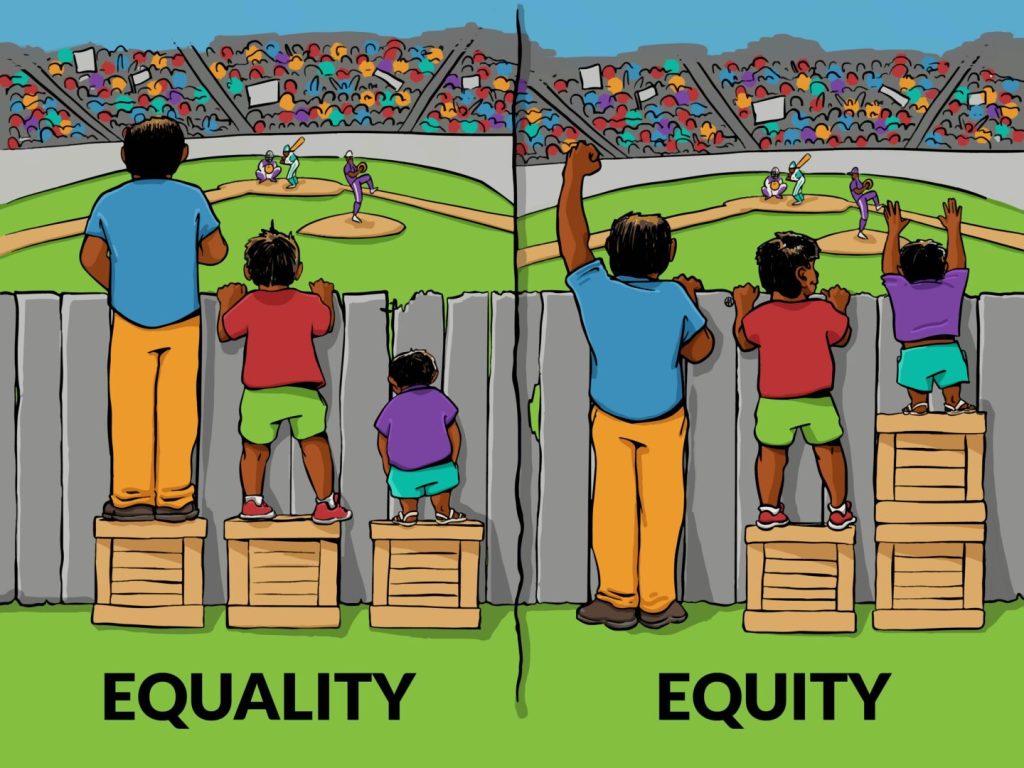
Image courtesy of Interaction Institute for Social Change
| Artist: Angus Maguire
Public Services Minister Judith Collins introduced legislation in August to remove diversity requirements for public service recruitment. Shouldn’t the disadvantaged starting the race of life fifty meters behind the rest, running against strong headwinds, fighting an uphill battle, deserve a leg up? A fair go in New Zealand?
This month, the All Blacks suffered their worst defeat in history, playing South Africa at home. To a diverse Springboks side led by an inspirational black captain, something unthinkable twenty years ago. Two consecutive World Cup championship wins were achieved through a successful Diversity and Inclusion (D&I) program.
“‘Everyone is equal under the law’ is a noble goal, but divorced from the reality of inequitable access to education, employment, housing, and health care – the fundamentals of life”, wrote Kate Kearins, Professor of Management and Pro Vice Chancellor, Auckland University of Technology. Her fear that New Zealand might follow Donald Trump in reversing diversity and inclusion efforts has come earlier than expected.
Many countries have neglected the left behind and are struggling to cope with the resulting problems. The far-right AFD captured all the seats in the former East Germany, outside Berlin, in the recent national elections. The USA, the UK, France, and Italy are among the bastions of democracy where populism has gained significant traction.
New Zealand has more to gain from diversity and inclusion than most countries. We have an indigenous Māori population, comprising 17% of the country, for whom we have treaty obligations, and 9% of our population is Pacifica. Raising the living standards of a quarter of our population will be a massive boost for our economy and improve social cohesion.
We must acknowledge why the Māori do poorly; the history, the impact of violence and neglect. What’s missing from most Treaty conversations is that the treaty was violated within five years. The treaty was signed in 1840. The land wars started in 1845. The full might of the British Empire was arrayed against poorly armed locals. Those fertile farms of Waikato were won by barge-mounted cannons on the River Waikato, against a few muskets. Systemic racism continued until well after World War 2, with Māori locked out of government programs like state housing until the late 1940s. The state gave all Pakeha veterans returning from World War 2 blocks of farmland, not the Maori.
South African Rugby is an outstanding example of successful D&I initiatives, unlocking a massive talent pool to complement an already exceptional team. Half the World Cup winning squad in 2023 were black and coloured players, a far cry from the era where one or two token-coloured players were in the team.
It was not an easy road in a country where apartheid reigned till the 1990s. Vocal critics of the D&I program voiced their derision and, at times, stubborn refusal. Diversity efforts began at the school level to ensure that school rugby teams reflected the school’s demographics and a wide range of players had opportunities to progress. A strong pipeline for representative and national teams.
The current Springboks coach, Rassie Erasmus, played a pivotal role in promoting diversity during his tenure as Director of High Performance. He was instrumental in establishing an Elite Player Development program with pathways for players from disadvantaged backgrounds and channelling them into elite player and high-performance programs. The representation of coloured players influenced more than Rugby, lifting morale and motivation in many areas.
A 2023 McKinsey study found that highly diverse leadership teams had 39% better financial returns and more satisfied workforces. Employees stay longer when they see leaders from similar backgrounds. Many of our public and private sector organisations promote diversity and reap the benefits. The winner of the 2024 D&I Award was the Ports of Auckland. The runners-up were the ANZ Bank and Powerco. 33% of employees in the Downer group are Māori and Pacifica. Our universities have increased their minority student intakes with enrollment targets.
The current coalition’s support for improving diversity ranges from non-existent to downright opposition. Prime Minister Luxon says he wants Māori to do well. However, his government’s anti-poor policies adversely impact Māori and Pacifica. Minimum-wage earners suffered an effective pay cut for two years. Government contractors are no longer required to pay a living wage. Jobseeker and Disabled Allowances are reduced to keep up with inflation. The Māori Health Board has been dismantled, while Māori experience significantly worse health and a seven-year life expectancy difference.
New Zealand has a proud history of doing the right thing, like being the first country to grant women the right to vote. Our gender pay gap is one of the lowest in the OECD. Diversity is not just ethical but essential for improving productivity. We are shooting ourselves in the foot by blocking diversity and inclusion initiatives. Our prosperity requires lifting everyone.

Leave a comment